
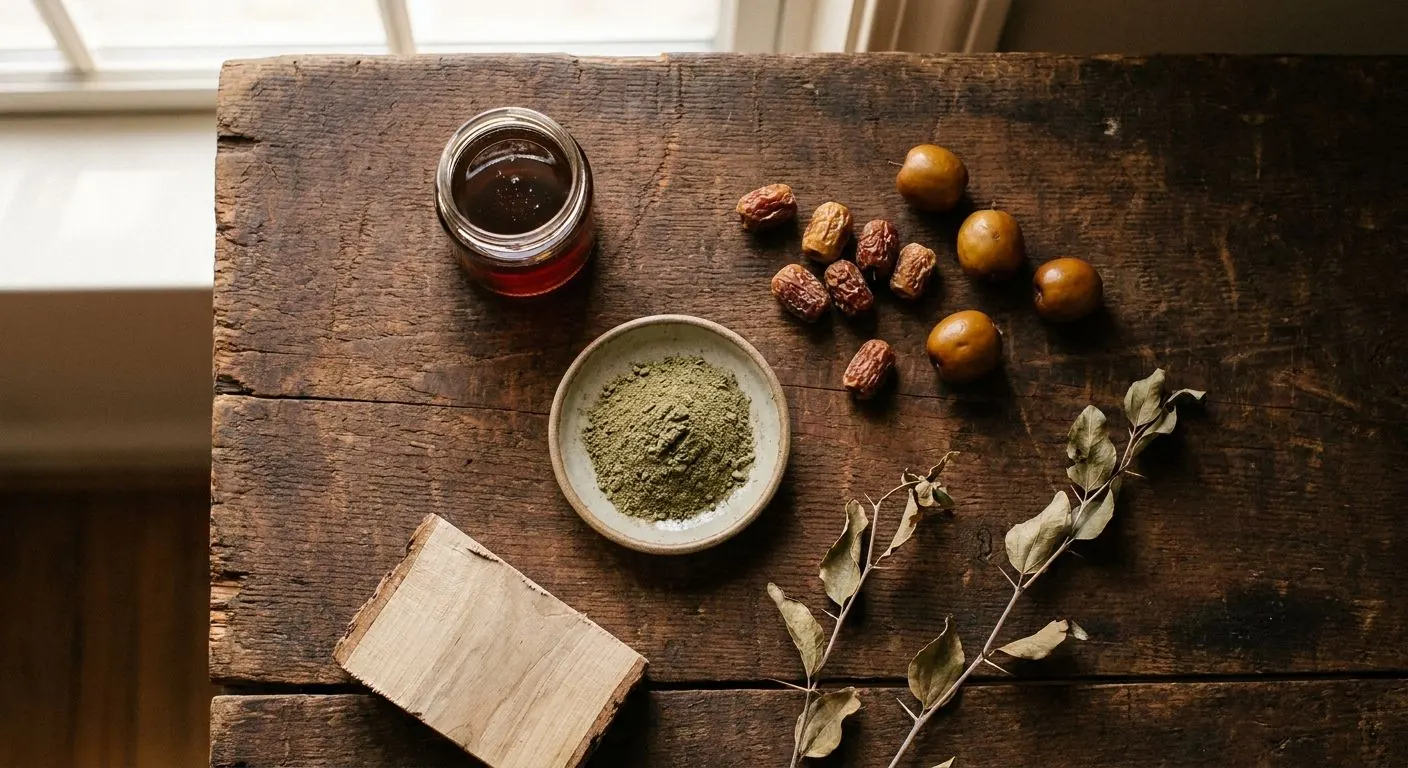
Sidr honey is the best-known thing the tree produces and the most expensive, but it is not the only one. In Yemen a mature Sidr is worked for four things: honey, fruit, leaf and wood.
Knowing what the others are is useful for one practical reason — it tells you whether a seller actually works with these trees or merely buys honey with the name on it.
Honey
Produced from the blossom during a bloom lasting weeks. Dense, slow-pouring, caramel-forward in the desert valleys and lighter and more floral in the highlands. It is the highest-value product by a wide margin and the reason the trees have commercial protection.
Fruit
A small drupe, roughly the size of a large olive, tasting somewhere between a date and an apple when fresh and more like a date when dried. It is eaten as an everyday fruit rather than treated as a delicacy, and it is rarely exported because it does not travel well.
Leaf
Dried and ground into a powder used as a hair and skin wash, a practice that predates the honey trade by a long way. The leaves contain saponins, which is why the powder lathers lightly in water.
Wood
Dense and slow-grown, historically used for tools, doors and building timber. It is also the reason the mature trees are vulnerable: a Sidr is worth more standing than felled only as long as the honey and fruit are worth something.
Which are worth seeking out
- Honey — the one worth paying for, if you can establish where and when it was harvested.
- Leaf powder — inexpensive, easy to try, and genuinely traditional.
- Fruit — worth eating if you are in the region; rarely worth buying dried and shipped.
- Wood — not something to buy at all, for the reason above.
Common questions
What does Sidr fruit taste like?
Fresh, something between a date and an apple, with a crisp texture. Dried, it is closer to a date. It is eaten as an everyday fruit in Yemen and rarely exported.
Can you use every part of the Sidr tree?
Effectively yes — blossom for honey, fruit for eating, leaves for washing powder, and wood for building. In practice the honey and the leaf are what reach international buyers.